
Injectable
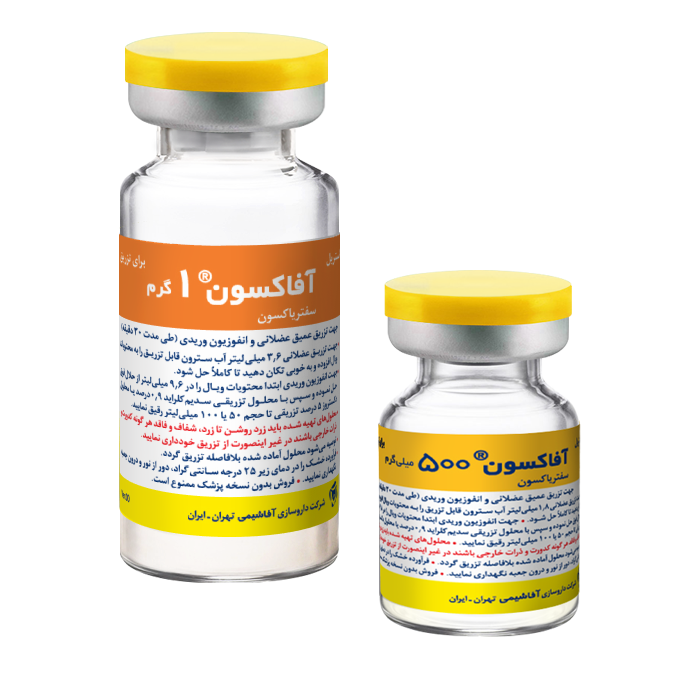
Powder for injection Ceftriaxone 500 mg, 1 g
General instructions for the patient:
This medicine has been prescribed for your current illness. Therefore, avoid using it in similar cases and recommending its use to others.
Before using this medicine, consult your doctor in the following cases:
1- If you have a history of allergy to penicillins, cephalosporins, penicillin derivatives, penicillamine, preservatives or dyes.
2- If you have other diseases, including: digestive diseases, bleeding disorders, liver and kidney failure.
3- If you are taking any other medication.
Use during pregnancy and lactation:
The use of the medicine during pregnancy and lactation should be under the advice of a specialist physician.
Warnings:
Avoid infusion of solutions prepared with lidocaine hydrochloride.
Avoid using solutions containing calcium, such as Ringer’s solution, to prepare or dilute the product.
If you experience any allergic reaction to the drug, stop taking the drug. In severe cases, immediate medical attention is required.
Take the drug at regular intervals and complete the course of treatment.
In case of severe diarrhea, contact your doctor and avoid taking antidiarrheal drugs on your own.
Ceftriaxone should be used with caution in infants with hyperbilirubinemia, especially premature infants.
This drug may interfere with blood sugar measurement tests, so inform your doctor before changing the dose of the antidiabetic drug.
In patients with simultaneous liver and kidney failure, the daily dose should not exceed 2 grams.
Intravenous infusion should be administered over 30 minutes.
Intramuscular injection should be performed deeply and in a large muscle.
This product contains approximately 3.6 milliequivalents of sodium per gram, so this medication should be administered with caution to patients on a salt restriction.
Dosage:
The dosage is determined by the physician, but the usual dosage of this medication is as follows:
Adults:
In gonorrhea infection (simple gonorrhea), 250 mg as a single dose by intramuscular injection.
In the prevention of infection before surgery, 1 gram intravenously half to 2 hours before the start of the operation.
In the treatment of other infections, 1 to 2 grams every 24 hours or 500 mg to 1 gram every 12 hours intramuscularly or intravenously.
The maximum daily dosage for adults is 4 grams.
Children:
In meningitis, 100 mg/kg body weight on the first day of treatment, up to a maximum of 4 g, by intramuscular or intravenous injection. Then 100 mg/kg body weight every 24 hours or 50 mg/kg body weight every 12 hours for 7 to 14 days (maximum daily dose of 4 g).
In otitis media, 50 mg/kg body weight up to a maximum of 1 g as a single dose by intramuscular injection.
In skin and soft tissue infections, 50 to 75 mg/kg body weight every 24 hours or 25 to 37.5 mg/kg body weight every 12 hours by intramuscular or intravenous injection (maximum daily dose of 2 g).
For other severe infections, 25 to 37.5 mg/kg body weight every 12 hours by intramuscular or intravenous injection (maximum daily dose of 2 g).
Preparation method:
To prepare the initial solution for intramuscular injection, add 1.8 and 3.6 ml of sterile water for injection to the ceftriaxone 500 mg and 1 g vials, respectively, and shake well. The resulting solution has a concentration of about 250 mg per ml.
To prepare the initial solution for intravenous infusion, add 4.8 and 9.6 ml of sterile water for injection to the ceftriaxone 500 mg and 1 g vials, respectively, and shake well. The resulting solution has a concentration of about 100 mg per ml. Then dilute the initial solution to a volume of 50 or 100 ml with 0.9% sodium chloride solution for injection or 5% dextrose for injection.
It is recommended that the resulting solution be used immediately after preparation.
After dissolving the powder, if foreign particles or turbidity are observed, do not inject.
The solution ready for injection is light yellow to amber, if the solution changes color and darkens, do not use it.
Drug interactions:
Avoid mixing ceftriaxone and aminoglycosides such as gentamicin for intravenous injection. If simultaneous administration is required, these drugs should be injected at two separate sites.
Avoid mixing ceftriaxone with vancomycin and fluconazole due to physical interactions.
Ceftriaxone is incompatible with calcium-containing solvents such as Ringer’s solution, so avoid using them for dilution.
Avoid using calcium-containing solutions or products simultaneously and even up to 48 hours after the last dose of ceftriaxone.
Side effects:
Every drug may cause some unwanted side effects in parallel with the desired therapeutic effect. Given that not all of these side effects are seen in one person. Consult your doctor if any of the following side effects occur:
Blood disorders such as eosinophilia, thrombocytopenia, leukopenia, hemolytic anemia, and agranulocytosis; allergic reactions such as fever, itching, and rash; thrombophlebitis including pain, stiffness, and swelling at the injection site; gastrointestinal complications such as pseudomembranous colitis, diarrhea, nausea, vomiting, and pseudogout formation.
Poisoning:
If you take more than the recommended dose, contact your doctor or poison control center.
Storage conditions:
Store the dry product at a temperature below 25°C, away from light, and in the box.
Avoid using expired medication.
Keep the medication out of the reach of children.
Dosage Forms and Packaging:
Afaxone® 500 Powder for Injection: Contains 500 mg of ceftriaxone (as sodium salt) and is packaged in a box of 20 with a leaflet.
Afaxone® 1 Powder for Injection: Contains 1000 mg of ceftriaxone (as sodium salt) and is packaged in a box of 20 with a leaflet.
Cephalosporins are one of the oldest and most numerous antibiotics that are effective against many pathogens and are produced in various dosage forms such as capsules, suspensions and injection vials, etc. These drugs, like penicillins, belong to the beta-lactam group. Ceftriaxone is a third-generation cephalosporin antibiotic.
Mechanism of action:
Antibacterial effect: Ceftriaxone is mainly bactericidal. However, it may also be bacteriostatic. Its activity depends on the organism, tissue penetration, drug dose and the rate of reproduction of the organism. This drug exerts its effect by binding to penicillin-binding proteins and inhibiting cell wall synthesis.
Ceftriaxone is effective against some gram-positive organisms and many gram-negative intestinal bacilli as well as streptococci. Most strains of Listeria, Pseudomonas and Acinetobacter are resistant to this drug. In general, the activity of ceftriaxone is very similar to that of cefotaxime and ceftizoxime
Absorption: Administered intramuscularly and intravenously.
Distribution: Widely distributed in most tissues and body fluids, such as the gallbladder, liver, kidney, bone, sputum,
bile, and synovial fluid. Unlike most cephalosporins, ceftriaxone penetrates well into the CSF and crosses the placenta. Its protein binding is dose-dependent and decreases with increasing serum concentration. It is approximately 84-96% protein-bound.
Metabolism: Partially metabolized.
Excretion: Excreted primarily in the urine. Some of the drug is excreted in the bile by biliary mechanisms, and small amounts are secreted in milk. The elimination half-life of the drug is 5.5-11 hours in adults with normal kidneys. Severe renal disease prolongs the half-life only moderately.
Ceftriaxone is used to treat infections caused by susceptible Gram-positive and Gram-negative bacteria, including bone and joint infections, pneumonia and bacterial pneumonia, skin and soft tissue infections, otitis media, and urinary tract infections. Ceftriaxone is also used for the empirical treatment of bacterial meningitis, as it is the most effective agent against Streptococcus pneumoniae. Ceftriaxone is also an excellent choice for the treatment of gonorrhea and salmonella.
Contraindications:
Sensitivity to cephalosporins or any of the excipients, neonates with high bilirubin levels, and premature infants (ceftriaxone causes the release of bilirubin from serum albumin).
Side effects:
Every drug may cause some unwanted effects along with its desired therapeutic effect. It should be noted that not all of these effects are seen in one person.
As with penicillins, hypersensitivity reactions are the most common side effects of cephalosporins, including: rash, itching, eosinophilia, thrombocytopenia, fever, serum sickness-like reactions, and anaphylactic reactions, which may occur even more frequently than with penicillins.
Other side effects of ceftriaxone include blood disorders such as eosinophilia, thrombocytopenia, leukopenia, hemolytic anemia, and agranulocytosis; allergic reactions such as fever, itching, and rash; thrombophlebitis including pain, tenderness, and swelling at the injection site; and gastrointestinal complications such as pseudomembranous colitis, diarrhea, nausea, vomiting, and pseudogout.
Broad-spectrum antibiotics, including cephalosporins, can enhance the effects of coumarin anticoagulants such as warfarin and dicumarol. Uric acid-sparing compounds such as probenecid and sulfinpyrazone may reduce the excretion of cephalosporins, and serum levels should be monitored if used concomitantly.
Mixing ceftriaxone and aminoglycosides such as gentamicin for intravenous injection should be avoided. If concomitant administration is necessary, these drugs should be injected at separate sites.
Mixing ceftriaxone with vancomycin and fluconazole causes physical interactions.
Ceftriaxone is incompatible with calcium-containing solvents such as Ringer’s solution, so their use for dilution should be avoided.
Simultaneous administration of calcium-containing solutions or products should be avoided, even up to 48 hours after the last dose of ceftriaxone.
Some recommendations to reduce the risk of dangerous side effects from taking ceftriaxone:
1- Strictly avoid prescribing the drug in cases such as colds and cases that are not among the approved uses of this product. Also, avoid replacing the injectable form of antibiotics in cases where oral forms are effective and can be prescribed.
2- It is recommended to check the person’s history of sensitivity to cephalosporins and penicillins before injecting ceftriaxone. The drug is prohibited for use in people sensitive to other cephalosporins, and in people sensitive to penicillin, the injection should be done with great caution only if necessary and the use of other drugs is not possible.
3- According to the new findings of the US Food and Drug Administration (FDA) and the report of death due to the simultaneous use of ceftriaxone with calcium-containing products, the simultaneous use of ceftriaxone with solutions or products containing calcium is prohibited, even by injection through different veins, and the use of solutions and products containing calcium is prohibited for 48 hours after the last dose of ceftriaxone in all age groups.
4- The use of calcium-containing diluents such as Ringer’s solution to prepare ceftriaxone for injection is prohibited.
5- Given the effect of ceftriaxone injection speed on the incidence and control of its complications, it is recommended to avoid rapid intravenous injection and to inject ceftriaxone in an appropriate solution for at least 15 to 30 minutes.
6- The drug should be injected only by experienced individuals and in centers equipped with a resuscitation system.
7- Due to ceftriaxone’s ability to displace bilirubin from its binding site to plasma albumin and the possibility of encephalopathy due to increased bilirubin levels, the use of ceftriaxone is prohibited in infants with hyperbilirubinemia (especially premature infants).
If you require our services and are seeking consultation from the Afachemi team, you can get in touch with our experts by completing the consultation form.


