
20 pieces
Oral
375mg -625mg
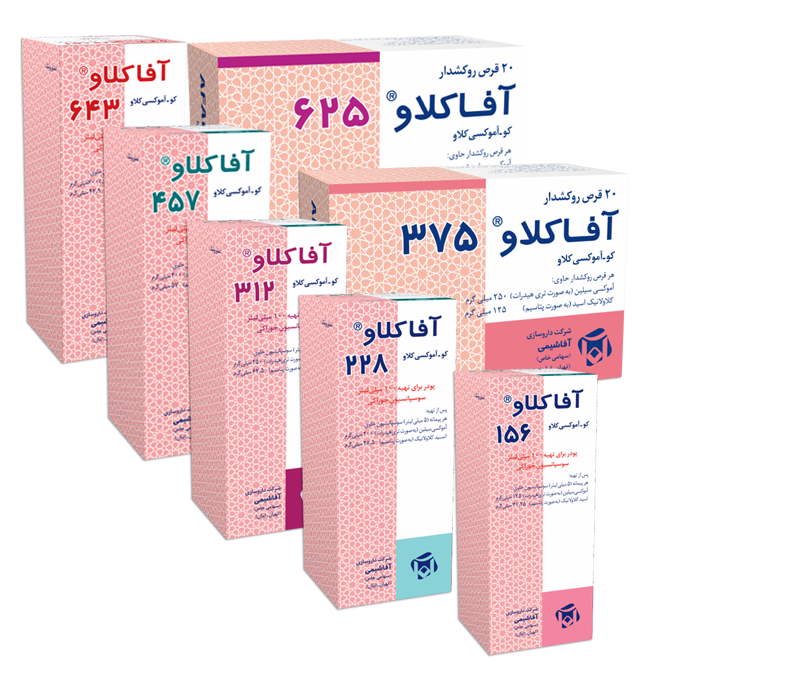
Afaclav®
Co. Amoxiclav
375 and 625 mg coated tablets
Powder for oral suspension 156, 312, 228, 457 and 643 mg in 5 ml
Scientific drug instructions for the patient:
This drug has been prescribed to treat your current illness, so avoid using it if it is being used by others.
General instructions:
A history of allergy to penicillins and cephalosporins (such as amoxicillin, cephalexin or other drugs, foods, preservatives and dyes.
If you have a low-salt diet.
If you are taking it simultaneously with oral anticoagulants, dipyridamole, heparin, painkillers especially aspirin, sulfinpyrarone, pentoxifylline, birth control pills, valproic acid and probenecid.
Kidney and liver disease, mononucleosis, phenylketonuria and stomach and intestinal diseases.
Use during pregnancy and breastfeeding:
The use of this medicine during pregnancy and breastfeeding should be done under the supervision of a physician.
Warnings:
Co-amoxiclav suspension contains phenylalanine, which is prohibited for use in patients with phenylketonuria.
If the disease does not improve after a few days of taking the medicine, inform your doctor.
To completely eliminate the infectious agent It is essential to follow the treatment course even if you see improvement.
To see a better therapeutic effect, it is recommended to take the medicine at the prescribed time.
To take the suspension, use the graduated measuring cup inside the box.
In case of severe diarrhea, contact your doctor and avoid taking anti-diarrhea medications in this situation without consulting your doctor.
Taking this medicine in diabetic patients may cause disturbances in the results of the urine sugar measurement test.
Dosage and method of taking the medicine:
The doctor determines the amount of each medicine, but the usual dosage of this medicine is as follows:
Adults weighing more than 40 kg (375 and 625 mg coated tablets): 250 to 500 mg of amoxicillin in combination with 125 mg of clavulanic acid every 8 hours or 500 to 875 mg of amoxicillin with 125 mg of clavulanic acid every 12 hours.
Infants over 12 weeks of age and children under 40 kg (156 and 312 mg oral suspension): 6.7 to 22.5 mg Amoxicillin per kg of body weight in combination with 1.7 to 3.2 mg of clavulanic acid per kg of body weight every 8 to 12 hours.
Infants over 3 months and children weighing less than 40 kg (oral suspension 643 mg): 90 mg per kg of body weight based on the amount of amoxicillin in divided doses every 12 hours.
Adults weighing more than 40 kg (oral suspension 228 and 457 mg):
500 to 875 mg of amoxicillin every 12 hours.
Infants over 12 weeks and children under 40 kg (oral suspension 228 and 457 mg):
12.5 to 22.5 mg of amoxicillin per kg of body weight every 12 hours. (depending on the type and severity of the infection)
Infants up to 12 weeks: The amount of medicine required is determined by the doctor, usually 15 mg
Amoxicillin per kg of body weight The baby’s body is every 12 hours, the use of clavulanic acid
is not recommended for babies.
How to prepare the suspension:
First shake the bottle to separate the powder from the bottle wall, then add boiled and cooled water in two stages to the mark line to the bottle containing the powder and shake the bottle well.
Shake the bottle well before each use.
Wash the measuring cup before and after each use.
Taking a missed dose:
If you forget to take a dose of the medicine, take it as soon as you remember, but if it is almost time for the next dose, skip it and take the medicine as before and do not double the dose.
Side effects:
In addition to the desired therapeutic effects, each medicine may have a series of side effects, although
not all of these side effects may appear in one person, but if any of them occur, it requires a doctor’s attention.
Side effects that require immediate discontinuation and immediate medical attention include: cough, irregular and rapid breathing, fever, joint pain, dizziness and numbness, vaginal itching and discharge, sudden syncope, facial swelling, redness and inflammation of the eyes, shortness of breath, skin rash with burning and itching, sores in the mouth and tongue, white spots in the mouth and tongue, and unusual fatigue and weakness.
Side effects that require medical attention: abdominal cramps with severe pain, painful abdominal cramps, seizures, decreased urine output, severe watery diarrhea (may be bloody), depression, nausea and vomiting, sore throat, sore throat and fever, unusual bleeding under the skin, yellowing of the eyes or skin, redness and inflammation of the tongue, chest pain, swelling of the face, fingers and toes, and difficulty urinating.
(Symptoms such as abdominal cramps with severe pain and severe watery diarrhea may also be observed for several weeks
after stopping the drug).
Side effects that disappear over time and as the body adapts to the drug and do not require a visit to the doctor, but if they persist or worsen, they require medical attention:
Moderate diarrhea, bloating, headache, stomach pain, difficulty swallowing, feeling cold, nosebleeds, and unusual fatigue.
Poisoning:
In case of accidental overdose, transfer the patient to a medical center.
Storage conditions:
Keep the medicine out of the reach of children.
Store the dry powder at a temperature below 25 degrees Celsius and away from moisture.
Store the tablets in a dry place at a temperature below 25 degrees Celsius.
After preparing the suspension with water, store it in the refrigerator and prevent it from freezing.
After 7 days of storage in the refrigerator, discard the prepared suspension.
Dosage forms:
Afaclav 375 mg coated tablets:
Each tablet contains 250 mg of amoxicillin (as trihydrate) and 125 mg of clavulanic acid (as potassium).
Afaclav 625 mg coated tablets:
Each tablet contains 500 mg of amoxicillin (as trihydrate) and 125 mg of clavulanic acid (as potassium).
Afaclav 156 powder for 100 ml oral suspension:
Each 5 ml contains 125 mg of amoxicillin (as trihydrate) and 31.25 mg of clavulanic acid (as potassium).
Afaclav 228 powder for 100 ml oral suspension:
Each 5 ml contains 200 mg of amoxicillin (as trihydrate) and 28.5 mg of clavulanic acid (as potassium).
Powder for preparation of 100 ml of oral suspension Afaclav 312:
Each 5 ml contains 125 mg of amoxicillin (as trihydrate) and 31.25 mg of clavulanic acid (as potassium).
Powder for preparation of 100 ml of oral suspension Afaclav 457:
Each 5 ml contains 400 mg of amoxicillin (as trihydrate) and 57 mg of clavulanic acid (as potassium).
Powder for preparation of 100 ml of oral suspension Afaclav 643:
Each 5 ml contains 600 mg of amoxicillin (as trihydrate) and 42.5 mg of clavulanic acid (as potassium).
Co-Amoxiclav is a combination antibiotic that contains amoxicillin (an antibiotic from the penicillin group) and clavulanic acid (a beta-lactamase inhibitor). This combination increases the effectiveness of amoxicillin against bacteria that are resistant to common antibiotics.
Amoxicillin destroys the cell walls of bacteria. However, some bacteria produce an enzyme called beta-lactamase that inactivates amoxicillin. Clavulanic acid inhibits this enzyme, allowing amoxicillin to do its job effectively.
Warfarin (increased risk of bleeding)
Methotrexate (increased drug toxicity)
Allopurinol (increased risk of skin reactions)
If you require our services and are seeking consultation from the Afachemi team, you can get in touch with our experts by completing the consultation form.


