
20 pieces
Injectable
500mg, 1g, 2g
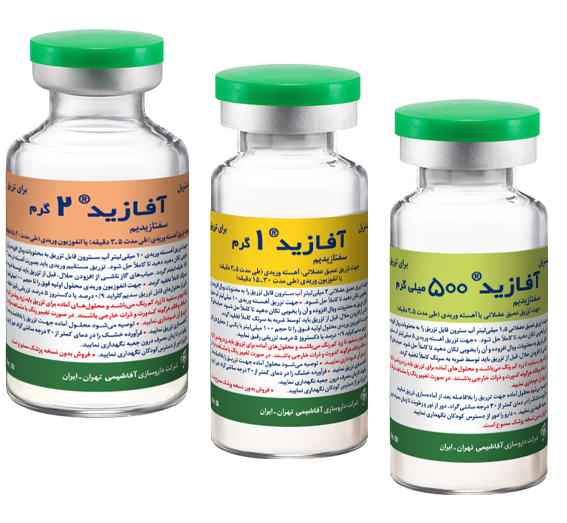
Afazid®
Cefazidime powder for injection 500 mg, 1 g and 2 g
This medicine has been prescribed for your current condition. Do not use it in similar cases or recommend it to others.
General instructions:
Before using this medicine, consult your doctor in the following cases:
If you have a history of allergy to penicillins, cephalosporins, penicillin-like drugs, penicillamine, preservatives and dyes
If you have kidney, liver or intestinal disease
If you are taking any type of medicine
Before performing laboratory tests
Use during pregnancy and lactation:
Use of this medicine during pregnancy and lactation should be under the advice of a specialist doctor.
Warnings:
If you experience any allergic reaction to the medicine, stop taking the medicine. In severe allergies, immediate medical action is required.
Take the medicine at regular intervals. Complete the course of treatment.
In case of severe diarrhea, contact your doctor and avoid self-medication with antidiarrheal drugs.
If symptoms do not improve, inform your doctor.
This drug causes false positive results in urine sugar. Therefore, inform your doctor before changing the dose of antidiabetic drugs.
Intramuscular injection should be done deeply and in a large muscle.
Intravenous injection should be done slowly over 3 to 5 minutes and intravenous infusion over 15 to 30 minutes.
This product contains approximately 2.3 milliequivalents of sodium per gram, so its administration to patients with sodium restrictions should be done with caution.
This drug is for use in a hospital.
Dosage:
The dosage of the drug is determined by the doctor. The usual dosage of the drug is as follows:
Adults:
In bone and joint infections, 2 grams every 12 hours by intravenous injection.
In intra-abdominal infections, meningitis, pelvic infections, gynecology and septicemia, 2 grams intravenous injection every 8 hours.
In pneumonia and skin and soft tissue infections, 500 mg to 1 gram every 8 hours by intramuscular or intravenous injection.
In respiratory infections of Pseudomonas origin, 30 to 50 mg per kilogram of body weight every 8 hours, up to a maximum of 6 grams per day by intravenous injection.
In complicated urinary tract infections, 500 mg every 8 to 12 hours by intramuscular or intravenous injection.
In uncomplicated urinary tract infections, 250 mg every 12 hours by intramuscular or intravenous injection.
For other severe to life-threatening infections, especially in immunocompromised patients, 2 grams every 8 hours by intravenous injection.
Note: In patients with impaired renal function, the dosage may need to be reduced.
Children:
In meningitis:
For infants and children from 1 month to 12 years, 50 mg per kilogram of body weight every 8 hours by intravenous injection.
For infants less than 1 month, 25 to 50 mg per kilogram of body weight every 12 hours by intravenous injection.
For other infections:
For infants and children from 1 month to 12 years, 30 to 50 mg per kilogram of body weight every 8 hours by intravenous injection.
For infants less than 4 weeks, 30 mg per kilogram of body weight every 12 hours by intravenous injection.
Note: Because the arginine compound is harmful to infants, the sodium form of this drug must be used in this age group.
The maximum dosage for children is up to 6 grams per day and for the elderly (over 75 years of age) up to 1 gram every 24 hours.
Preparation method:
To prepare a solution for intramuscular injection, add 1.5 and 3 ml of sterile water for injection to 500 mg and 1 gram ceftazidime vials, respectively, and shake well.
To prepare an initial solution for intravenous injection, add 5 ml of sterile water for injection to 500 mg ceftazidime vials or 10 ml of sterile water for injection to 1 or 2 gram ceftazidime vials and shake well. Direct intravenous injection should be done slowly over 3 to 5 minutes. Gas bubbles caused by the addition of solvent should be completely evacuated by tapping the syringe before injection.
For intravenous infusion, dilute the initial intravenous injection solution to a volume of 100 ml with one of the injectable solutions of 0.9% sodium chloride or 5% dextrose for injection.
It is recommended to inject the solution ready for injection immediately after preparation.
After dissolving the powder, if foreign particles or turbidity of the solution are observed, do not inject.
The color of the powder is white to pale yellow and the solution ready for injection is light yellow to amber. Do not use if the color changes.
Drug interactions:
Avoid mixing ceftazidime and aminoglycosides such as gentamicin for intravenous injection. If simultaneous administration is required, these drugs should be injected at two separate sites.
Avoid mixing ceftazidime with vancomycin due to physical interactions and the possibility of sediment formation.
Side effects:
Every drug may cause some unwanted side effects in parallel with the desired therapeutic effect. Since not all of these side effects will occur in the same person, consult your doctor if any of the following side effects occur:
Diarrhea, nausea, vomiting, stomach cramps, itching, fever, skin rash, inflammation at the injection site, headache, dizziness, seizures, and sensory disturbances.
Storage conditions:
Store the dried product at a temperature below 30°C away from light and moisture and in the original box.
Avoid using expired medicine.
Keep the medicine out of the reach of children.
Dosage forms and packaging:
Cefazidime powder for injection 500 mg: Each vial contains 500 mg of ceftazidime as pentahydrate and is packaged in a box of 20 with a leaflet.
Cefazidime powder for injection 1 g: Each vial contains 1 g of ceftazidime as pentahydrate and is packaged in a box of 20 with a leaflet.
Cefazidime powder for injection 2 g: Each vial contains 2 g of ceftazidime as pentahydrate and is packaged in a box of 10 with a leaflet.
Ceftazidime is a third-generation cephalosporin that is effective against gram-negative bacteria, especially Pseudomonas species. Third-generation cephalosporins have relatively less activity against gram-positive cocci than first-generation cephalosporins, but are highly resistant to beta-lactamases from Haemophilus influenzae, Neisseria gonorrhoeae, and Moraxella catarrhalis. Some third-generation cephalosporins, such as ceftazidime, are effective against Pseudomonas aeruginosa, but are less effective against gram-positive cocci than others.
Ceftazidime can penetrate the CSF well and is used in the treatment of meningitis. This drug is used to treat infections caused by gram-positive and gram-negative bacteria sensitive to the drug, including biliary tract infections, cystic fibrosis, respiratory infections, treatment of infectious diseases in patients with weakened immune systems, peritonitis, pneumonia, septicemia, skin infections, and prevention of infection after surgery.
Mechanism of action
Like penicillins, it is effective on the bacterial wall. Ceftazidime causes osmotic instability of bacteria by inhibiting bacterial cell wall synthesis and has bactericidal effects.
The peak serum concentration of the drug is achieved one hour after intramuscular injection. The plasma half-life of the drug is about 2 hours, which increases in case of kidney failure. This drug is excreted in the bile. Ceftazidime is excreted primarily by the kidneys, via glomerular filtration.
The risk of kidney damage increases when ceftazidime or other cephalosporins are used concomitantly with aminoglycosides such as gentamicin and vancomycin. The anticoagulant effects of warfarin may be increased when used concomitantly with this drug.
If you require our services and are seeking consultation from the Afachemi team, you can get in touch with our experts by completing the consultation form.


