
20 pieces
Injectable
250mg , 500mg, 1g
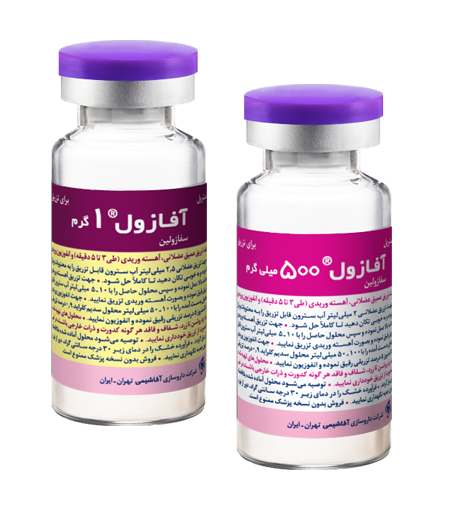
Afazol®
Cefazolin powder for injection 250, 500 and 1000 mg
General patient instructions:
This medicine has been prescribed to treat your current condition, so do not use it in similar cases or recommend it to others.
Before taking this medicine, consult your doctor in the following cases:
If you have a history of allergy to penicillin and cephalosporin drugs, other drugs, foods, preservatives and dyes.
If you are taking drugs containing alcohol, aminoglycosides, antacids, ranitidine and other histamine H2 receptor antagonists, anticoagulants, thrombolytic compounds, diuretics and iron.
If you are pregnant and breastfeeding
If you have a history of colitis, digestive disorders, bleeding disorders, liver failure and kidney failure.
Use in pregnancy and lactation:
Pregnancy: This drug is classified as FDA Category B. Use of this drug during pregnancy should be under the advice of a specialist.
Lactation: Cefazolin is secreted in small amounts in breast milk. Use of this drug during lactation should be under the advice of a specialist.
Warnings:
People with a history of allergy to penicillin, penicillin derivatives, or penicillamine may also be sensitive to cefazolin. Cases of severe allergy and even anaphylactic reactions have been reported in penicillin-sensitive people after administration of cefazolin.
If no improvement in symptoms is observed within a few days after use, inform your doctor.
Taking this drug may interfere with blood sugar measurement tests, so inform your doctor before changing the dose of antidiabetic medication.
In cases of severe diarrhea, consult your doctor before taking any medication.
Intravenous infusion should be administered over 30 minutes.
Intramuscular injection should be given deep into a large muscle.
Each gram of this product contains approximately 48 mg of sodium, so this medication should be administered with caution to patients on a salt restriction.
Dosage and method of administration:
The dosage of each drug is determined by the doctor, but the usual dosage of this drug is as follows:
In the prevention of infection before surgery: 1 gram, half to one hour before the start of surgery, 500 mg to 1 gram during surgery, and 500 mg to 1 gram every 6-8 hours to 24 hours after surgery by intramuscular or intravenous injection.
In the treatment of other infections:
In mild infections, 250 to 500 mg every 8 hours by intramuscular or intravenous injection.
In severe infections, 500 mg to 1 gram every 6-8 hours by intramuscular or intravenous injection.
In very severe infections, 1 to 1.5 grams every 6 hours by intramuscular or intravenous injection.
Children and infants older than one month: 25-6.25 mg per kilogram of body weight every 6 hours or 33.3-8.3 mg per kilogram of body weight every 8 hours by intramuscular or intravenous injection.
Infants less than one month old: 20 mg per kg of body weight every 8-12 hours by intravenous injection.
Missed dose:
If you miss a dose, take it as soon as you remember. If it is almost time for your next dose, take the next dose as scheduled and do not double the dose.
Preparing vials for injection:
Intramuscular injection: To prepare a solution of cefazolin for intramuscular injection, add 2 ml of sterile water for injection to each 250 or 500 mg vial and 2.5 ml to each 1 g vial.
Slow intravenous injection: For intravenous injection, follow the instructions above for the 250 mg, 500 mg, and 1 g vials. Then add 5-10 ml of sterile water for injection to the vial and inject the resulting solution slowly into the vein over 3-5 minutes.
Intravenous infusion: For intravenous infusion, dilute the resulting solution for slow intravenous injection with 50-100 ml of 5% dextrose solution for injection or 0.9% sodium chloride solution for injection.
Side effects:
In addition to the desired therapeutic effect, any drug may cause some unwanted effects, although not all of these effects may occur in the same person.
Side effects that require medical attention: eosinophilia, hypersensitivity reactions, agranulocytosis
Side effects that require medical attention if they persist or worsen during treatment: gastrointestinal disorders, headache, oral and vaginal candidiasis, dizziness, drug fever.
Side effects that indicate the possibility of pseudomembranous colitis and require medical attention if they occur after discontinuation of the drug: severe abdominal pain or cramps, severe and watery diarrhea that may be bloody, and fever.
Storage and stability conditions of the medicinal product:
Store the dry powder at a temperature below 30°C, away from light and in the box.
Inject the resulting solution immediately after preparation.
Note: The color of the ready-to-inject solution is pale yellow to yellow.
Dosage forms and packaging:
Afazol® 250 mg powder for injection: Each vial contains 250 mg of cefazolin (as sodium salt) and is packaged in a box of 20 with a leaflet.
Afazol® 500 mg powder for injection: Each vial contains 500 mg of cefazolin (as sodium salt) and is packaged in a box of 20 with a leaflet.
Afazol® Powder for Injection 1 gram: Each vial contains 1000 mg of cefazolin (as sodium salt) and is packaged in a box of 20 with an instruction leaflet.
Cefazolin is a first-generation cephalosporin antibiotic. Cefazolin is used to treat infections caused by susceptible gram-positive and gram-negative bacteria, including urinary tract infections, especially during pregnancy, and as a prophylaxis before surgery. Other uses of cefazolin include the treatment of severe respiratory tract infections, genitourinary tract infections, skin, soft tissue, bone and joint infections; biliary tract infections, septicemia, endocarditis caused by susceptible organisms, and prevention of surgical site infections.
Mechanism of action:
Antibacterial effect: Cefazolin is primarily a bactericidal drug, but it may also have bacteriostatic effects. The degree of activity of this drug depends on the type of organism, the extent of drug penetration into the tissue, the dose of the drug, and the rate of reproduction of the organism. Cefazolin binds to proteins that bind penicillin, thereby inhibiting bacterial cell wall synthesis. Cefazolin is effective against Escherichia coli, Enterobacteriaceae, Haemophilus influenzae, Klebsiella, Proteus mirabilis, Staphylococcus, Streptococcus pneumoniae, and Streptococcus (group A beta-hemolytic).
Absorption: Not well absorbed from the gastrointestinal tract and must be administered by injection.
Distribution: Widely distributed in most body tissues and fluids, such as the gallbladder, liver, kidneys, bone, sputum; bile, synovial fluid, and peritoneum. Penetration of the drug into cerebrospinal fluid (CSF) is very low. It crosses the placenta. About 74-86% of it is protein bound.
Metabolism: Not metabolized.
Excretion: Excreted mainly unchanged in the urine by renal tubular secretion and glomerular filtration. A small amount is excreted in breast milk. Its elimination half-life is about 1-2 hours in patients with normal renal function, and 12-50 hours in patients with very advanced renal disease. Cefazolin can be removed from the body by hemodialysis or peritoneal dialysis.
Probenecid competes with cephalosporins for tubular secretion in the kidneys and therefore inhibits their renal excretion. Consequently, concomitant use of probenecid with this drug may result in increased serum concentrations and prolonged drug exposure.
Concomitant use of this drug with drugs that cause nephrotoxicity (vancomycin, colistin, polymyxin B, and aminoglycosides) or diuretics that act on the loop of Henle increases the risk of nephrotoxicity.
Concomitant use with drugs that have a bacteriostatic effect (tetracyclines, erythromycin, or chloramphenicol) may inhibit the bactericidal activity of this drug. Avoid concomitant use.
If you require our services and are seeking consultation from the Afachemi team, you can get in touch with our experts by completing the consultation form.


