
10 pieces
Injectable
500mg
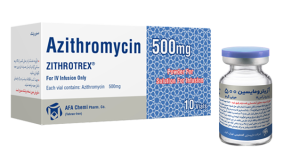
Zithrotrex® (azithromycin) 500 mg
Pharmaceutical form:
Azithromycin IV 500 mg powder for solution for infusion
Azithromycin powder vial 500 mg for infusion
Unique pharmacokinetic advantages and features:
Targeted effect and excellent penetration into lung tissue
Short duration of treatment
High tolerance
Less contraindications and unwanted side effects
Rapid onset of effect
Long-term efficacy
Once-daily administration
Easy administration
Minimum arrhythmogenicity among macrolides
Potential and unique antibacterial effect on atypical pathogens
Suitable post-antibiotic effect
Tissue concentration higher than serum level
Long half-life
Therapeutic applications:
-In the treatment of community-acquired pneumonia with susceptible organisms including Legionella pneumoniae in patients requiring initial intravenous therapy.
-In the treatment of pelvic infections caused by susceptible organisms in patients requiring initial intravenous therapy.
Pharmacodynamic effects:
Azithromycin is the first drug in the macrolide antibiotic subgroup called azalides, which is chemically different from erythromycin.
Mechanism of action:
Azithromycin binds to the 23S rRNA subunit of the 50S ribosomal subunit. Azithromycin blocks protein synthesis by inhibiting the translocation/transpeptidation step of the protein center and inhibiting the assembly of the 50S ribosomal subunit.
Resistance Mechanism:
Two common mechanisms of resistance to macrolides, including azithromycin, are:
Target modification (due to methylation of 23S rRNA)
– active efflux
The occurrence of these resistance mechanisms varies from one bacterial strain to another, and within each strain, the frequency of resistance varies depending on geographical location.
Efflux pumps are produced in a number of bacterial strains, including gram-negative bacteria such as Haemophilus influenzae and Staphylococcus. Efflux pumps are also expressed in Streptococcus and Enterococcus.
Method and dosage:
Adult use:
For the treatment of community-acquired pneumonia:
500 mg in a single daily dose as an intravenous infusion for at least 2 days, followed by intravenous therapy with oral therapy at a dose of 500 mg once a day for 7 to 10 days.
The time of transition from intravenous therapy to oral therapy is determined by the attending physician based on the patient’s clinical response.
In the treatment of pelvic infection:
500 mg in a single daily dose as an intravenous infusion for 1 or 2 days, followed by intravenous therapy with oral therapy at a dose of 250 mg once a day for 7 days.
The time of transition from intravenous therapy to oral therapy is determined by the patient’s clinical response and by the attending physician.
Use in the elderly:
The dosage in elderly patients is prescribed as in adults. Since elderly patients are more susceptible to cardiac arrhythmias, special caution is recommended in prescribing this drug in the elderly due to the risk of cardiac arrhythmias and torsade de points.
Use in children:
The efficacy and tolerability in the treatment of infections in children and adolescents under 16 years of age have not been proven.
In RCT studies, oral azithromycin has been prescribed to children (6 months to 16 years of age).
Recently, clinical guidelines for the administration of Off-Label /Unlabeled intravenous azithromycin in children and infants have been published.
How to prepare and use:
The initial solution is prepared by adding 4.8 mL of distilled water to the vial containing the powder and shaking the vial until the powder is completely dissolved. (Concentration: 100 mg Azithromycin/1mL)
Warning: The drug prepared for intravenous injection should be carefully inspected to ensure the absence of particles in the initial solution. If suspended particles are observed, the solution should be discarded.
Then, to obtain a concentration of 1 to 2 mg of azithromycin per ml, the above prepared solution should be added to a volume of 250-500 ml of a suitable solvent (0.9% sodium chloride, 0.45% sodium chloride, Ringer’s lactate-glucose 5% in water, 5% glucose in 0.45% sodium chloride, 5% glucose in 0.3% sodium chloride, 5% glucose in Ringer’s lactate) using a standard 5 ml syringe.
Final concentration of the solution for infusion solvent volume
1mg/mL 250 mL
2mg/mL 500 mL
Intravenous administration of a 500 mg dose of azithromycin diluted according to the above instructions should be carried out over a period of at least 60 minutes.
Concentration of prepared solution and duration of intravenous infusion:
mg/mL in 3 hours or1
mg/mL in 1 hours2
After preparation and dilution, it should be administered via intravenous infusion.
Warning:
Avoid intramuscular injection with direct intravenous injection.
Macrolides are a group of antibiotics containing a large macrocyclic lactone ring (macrolide ring). The most important drugs in this family are azithromycin, erythromycin, and clarithromycin. The mechanism of action of macrolides as inhibitors of bacterial protein synthesis appears to be through inhibition of peptidyl transferase and the binding of peptidyl to the tRNA of the protein amino acid.
Their mechanism of action is by inhibiting protein synthesis as a result of reversible binding to the S50 subunit of the bacterial ribosome. Although macrolides are best known as bacteriostatic drugs (with the ability to stop bacterial growth), at high concentrations they can also exhibit bacteriocidal effects (with the ability to kill bacteria).
Azithromycin is prescribed for the treatment of a wide range of bacterial infections. Uses include:
Respiratory infections: such as chronic bronchitis, pneumonia
Ear, nose and throat infections: such as middle ear infections, sinusitis, sore throat
Skin infections: wounds, acne
Genital and urinary tract infections: including gonorrhea, chlamydia
Gastrointestinal infections: including Helicobacter pylori infections
Absorption:
-Azithromycin is completely absorbed from the gastrointestinal tract, but the rate of absorption is slow. Maximum plasma concentration (C_max) is usually achieved 2-3 hours after oral administration.
-The absorption of this drug is affected by food, but food only delays the time to reach C_max, not the overall extent of absorption.
-The bioavailability of azithromycin is on average about 37%.
Distribution:
-Azithromycin is well distributed in tissues and its concentration in tissues (such as lungs, tonsils, skin and various organs of the body) is much higher than in blood plasma.
-This drug is about 50-70% bound to plasma proteins.
-The volume of distribution (V_d) of azithromycin is about 31 liters.
Metabolism:
-Azithromycin is mainly metabolized in the liver. It is not metabolized by the CYP450 enzyme system, so it has fewer drug interactions with drugs that affect this pathway.
-Only 10-15% of the administered dose is present in the body as active metabolites.
Half-life:
The plasma concentration of azithromycin is about 68 hours. This long half-life is a special feature of this drug, which allows only one daily dose to be sufficient to treat diseases.
-In tissues, especially in mucous glands, the half-life is even longer.
Excretion:
-Azithromycin is excreted mainly in the bile in unchanged form (about 50% of the administered dose). A small amount is also excreted in the urine (about 6%).
-The duration of the drug’s residual time in the body eliminates the need for repeated doses during treatment.
Special pharmacokinetic features:
-The long distribution and persistence of the drug in tissues ensures its long-term effectiveness and allows for one or two doses per day.
-Azithromycin is rapidly transported from the bloodstream to the tissues and accumulates there, so unlike many antibiotics that must remain in the blood plasma for a long time, azithromycin can be effective with lower doses and shorter treatment durations.
Heart medications: such as amiodarone, sotalol (increased risk of arrhythmia).
Warfarin: increased anticoagulant effect.
Antacids: reduced absorption of azithromycin (taken 2 hours apart).
Digoxin: increased serum digoxin levels.
If you require our services and are seeking consultation from the Afachemi team, you can get in touch with our experts by completing the consultation form.


