
10 pieces
Injectable
500mg, 1g
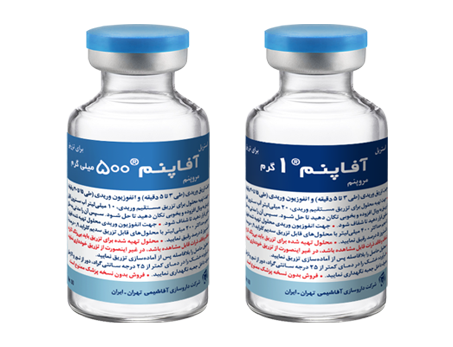
Ofapnem®
Meropenem powder for injection 500 and 1000 mg
This medicine has been prescribed for your current condition. Therefore, do not use it in similar cases or recommend it to others.
General instructions:
Before using this medicine, consult your doctor in the following cases:
If you have a history of allergy to other medicines and beta-lactam antibiotics (penicillins, cephalosporins and imipenem).
If you have other diseases, including kidney failure, nervous system disorders (history of seizures) and bacterial meningitis.
If you are taking other medicines, especially antiepileptic drugs (valproic acid) and probenecid.
Before performing laboratory tests (especially urine sugar).
Use in pregnancy and lactation:
Pregnancy: This medicine is classified as FDA category B. Use of this medicine during pregnancy should be under the advice of a specialist.
Breastfeeding: Meropenem excretion in breast milk has not been determined. Therefore, the use of this drug during breastfeeding should be under the advice of a specialist.
Warnings:
In case of any allergic reaction to the drug, stop taking the drug. In severe allergies, urgent medical measures are required.
Take the drug at regular intervals and complete the course of treatment.
In case of severe diarrhea, contact your doctor and avoid taking antidiarrheal drugs on your own.
In patients with renal failure, the dosage should be adjusted according to the severity of the disease.
In patients with a history of epilepsy, the use of anticonvulsants should be continued as directed by the doctor.
Each gram of this product contains approximately 3.92 milliequivalents of sodium, so the administration of this drug to patients who have salt restrictions should be done with caution.
This drug is for use in hospitals only.
Dosage:
The doctor determines the dosage of the drug. However, the usual dosage of the drug is as follows:
Adults:
In the treatment of bacterial infections: 1 gram as an intravenous infusion over 15 to 30 minutes or intravenous injection over 3 to 5 minutes every 8 hours.
In the treatment of skin infections: 500 mg as an intravenous infusion over 15 to 30 minutes or intravenous injection over 3 to 5 minutes every 8 hours.
In febrile neutropenia: 1 gram as an intravenous infusion over 20 to 30 minutes every 8 hours.
Children:
Infants under 3 months: The safety and efficacy of this drug in infants under 3 months have not been established.
In intra-abdominal infections:
In children weighing more than 50 kg: 1 gram as an intravenous infusion over 15 to 30 minutes or intravenous injection over 3 to 5 minutes every 8 hours.
In children older than 3 months and weighing less than 50 kg: 20 mg per kg of body weight as an intravenous infusion over 15 to 30 minutes or as an intravenous injection over 3 to 5 minutes every 8 hours.
The maximum dose is 1 gram every 8 hours.
In meningitis:
In children weighing more than 50 kg: 2 grams as an intravenous infusion over 15 to 30 minutes or as an intravenous injection over 3 to 5 minutes every 8 hours.
In children older than 3 months and weighing less than 50 kg: 40 mg per kilogram of body weight as an intravenous infusion over 15 to 30 minutes or as an intravenous injection over 3 to 5 minutes every 8 hours.
The maximum dose is 2 grams every 8 hours.
In the treatment of skin infections:
In children weighing more than 50 kg: 500 mg as an intravenous infusion over 15 to 30 minutes or as an intravenous injection over 3 to 5 minutes every 8 hours.
In children older than 3 months and weighing less than 50 kg: 10 mg per kilogram of body weight as an intravenous infusion over 15 to 30 minutes or as an intravenous injection over 3 to 5 minutes every 8 hours.
The maximum dose is 500 mg every 8 hours.
Febrile neutropenia:
In children weighing more than 50 kg: 1 g as an intravenous infusion over 20 to 30 minutes every 8 hours.
In children older than 3 months and weighing less than 50 kg: 20 mg per kg of body weight as an intravenous infusion over 20 to 30 minutes every 8 hours.
How to use the drug:
To prepare a solution for direct intravenous injection: Add 10 and 20 ml of sterile water for injection to the 500 mg and 1 g meropenem vials, respectively, and shake well to dissolve. Then let the vial stand for a while until it becomes clear. The resulting solution has a concentration of about 50 mg per ml. Inject the resulting solution over 3 to 5 minutes.
To prepare a solution for intravenous infusion: Dilute the solution prepared for direct intravenous injection to a maximum volume of 200 ml for 500 mg meropenem and 400 ml for 1 g meropenem with 0.9% sodium chloride injection or 5% dextrose injection. Infuse the resulting solution within 15 to 30 minutes.
Solutions prepared for injection should be clear, colorless and free of any visible particles. Otherwise, do not inject.
Use the solutions prepared for injection immediately and discard any remaining drug after single use.
Drug interactions:
The compatibility of meropenem with other drugs has not been established. Meropenem should not be mixed with other drugs or solutions containing other drugs.
Side effects:
Every drug may cause some unwanted effects along with the desired therapeutic effect.
Side effects that require medical attention if they occur include:
Inflammation and pain at the injection site, apnea, itching and skin rashes, shock (cold and clammy skin, confusion, dizziness, fast and weak heartbeat, sweating and respiratory distress), abnormal bleeding (black and bloody stools, bloody vomiting and nosebleeds), pseudomembranous colitis (including cramps and severe abdominal pain, severe watery diarrhea sometimes with blood and fever), seizures and blood complications.
Side effects that require medical attention if they persist or worsen include:
Anemia (pale skin, difficulty breathing, abnormal bleeding, unusual fatigue and weakness), digestive disorders (constipation, diarrhea, nausea and vomiting), pain, low blood sugar and headache.
Note: Pseudomembranous colitis may also occur after discontinuation of the drug, in which case it also requires medical attention.
Storage conditions:
Store the dry product at a temperature below 25°C, away from light and in the box until use.
Use the prepared solution for injection immediately.
Avoid using expired medicine.
Keep the medicine out of the reach of children.
Dosage forms and packaging:
Afapenem® 1g powder for injection: Each vial contains 1000 mg of meropenem (as trihydrate) and is packaged in a box of 10 with a leaflet.
Afapenem® 500mg powder for injection: Each vial contains 500 mg of meropenem (as trihydrate) and is packaged in a box of 10 with a leaflet.
Meropenem is a broad-spectrum antibiotic of the beta-lactam and penem class that is remarkably stable against hydrolysis by penicillinase and cephalosporinase (except metallo-beta-lactamase) produced by gram-positive and gram-negative microorganisms. The drug inhibits bacterial cell wall synthesis. Meropenem is used in the treatment of infections including intra-abdominal infections, meningitis, respiratory tract infections, septicemia, skin and soft tissue infections, and urinary tract infections.
Meropenem inhibits bacterial cell wall synthesis. The drug penetrates extensively into the cell walls of most gram-positive and gram-negative bacteria and binds to penicillin-binding proteins.
Absorption: The drug is administered intravenously. Distribution: It is distributed to most tissues and most body water. Only 2% of the drug is protein bound.
Excretion: The drug is excreted unchanged, mainly in the urine. The elimination half-life of the drug in adults with normal renal function and in children two years of age and older is about one hour, and in children three months to two years of age it is about one and a half hours.
Metabolism:
It appears to be metabolized to a negligible extent. An inactive metabolite has been identified for the drug. Contraindications: Hypersensitivity to the drug or other drugs of this class and individuals who have shown anaphylactoid reactions to beta-lactam drugs.
Precautions: Use with caution in cases of seizures and impaired renal function.
General characteristics of interactions:
– OAT1 substrate
– OAT3 substrate
– Changes in normal gastrointestinal flora
– Impaired immune response to bacterial agents
– Decreased seizure threshold
Class X interactions (avoidance):
B.T.G (intravesical), smallpox vaccine, probenecid
Reduced effects of drugs by meropenem:
B.T.G (intravesical), B.T.G vaccine (immunogenic), smallpox vaccine, lactobacillus and estriol, sodium picosulfate, typhoid vaccine, valproate preparations
Increased effects of meropenem by drugs:
Probencid
If you require our services and are seeking consultation from the Afachemi team, you can get in touch with our experts by completing the consultation form.


