
10 pieces
Injectable
250mg , 500mg
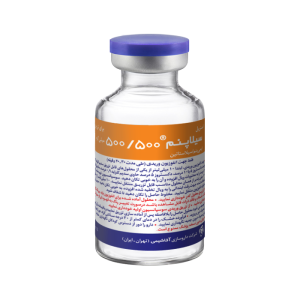
Cilapenem®
Imipenem-Cilastatin Injection Powder 250/250 and 500/500 mg
This medicine has been prescribed for your current condition. Therefore, do not use it in similar cases or recommend it to others.
General instructions:
Before using this medicine, consult your doctor in the following cases:
If you have a history of allergy to penicillins, cephalosporins or other allergens.
If you have gum or dental diseases.
If you have other diseases such as kidney failure, CNS disorders, history of seizures or brain injuries.
If you are taking other medications.
If you are pregnant or breastfeeding.
Use during pregnancy and breastfeeding:
Pregnancy: This medicine is classified as FDA category C. Use of this medicine during pregnancy should be under the advice of a specialist.
Breastfeeding: It is not known whether imipenem-cilastatin is excreted in breast milk. Use of this drug during breastfeeding should be under the advice of a specialist.
Warnings:
In case of any allergic reaction to the drug, stop taking the drug. In severe cases, urgent medical measures are required.
Take the drug at regular intervals and complete the course of treatment.
If the symptoms of the disease do not improve, inform the doctor.
In case of diarrhea, contact the doctor and avoid taking antidiarrheal drugs on your own.
In patients with renal failure, the dosage should be adjusted according to the severity of the disease.
Avoid intravenous injection of the initial suspension.
In patients with a history of seizures, anticonvulsant drugs should be continued.
This drug is for hospital use only.
This drug is for intravenous infusion over 20-30 hours only.
Each 250/250 mg vial of this product contains 0.8 milliequivalents of sodium and each 500/500 mg vial of this product contains 1.6 milliequivalents of sodium. Therefore, this drug should be used with caution in patients with sodium restrictions.
Dosage:
The dosage of the drug is determined by the doctor. However, the usual dosage of the drug is as follows:
Adults:
In the treatment of mild infections: 250 to 500 mg every 6 hours.
In the treatment of moderate infections: 500 mg every 6-8 hours to 1 gram every 8 hours.
In the treatment of severe and life-threatening infections: 500 mg every 6 hours to 1 gram every 6-8 hours.
Note: Lower doses are usually used in the treatment of gram-positive, anaerobic, and sensitive gram-negative infections. Treatment of infections caused by other gram-negative organisms requires higher doses.
For uncomplicated urinary tract infections: 250 mg every 6 hours.
For complicated urinary tract infections: 500 mg every 6 hours.
For febrile neutropenia: 500 mg every 6 hours to 1 g every 8 hours.
Children:
In children under 12 years of age, the dosage is determined by a specialist.
In children over 12 years of age (or weighing more than 40 kg), the usual adult dosage is used.
Note: Given that benzyl alcohol poisoning has been observed in infants under 3 months of age, it is recommended that solvents containing benzyl alcohol not be used to prepare this drug for intravenous infusion in this group of patients.
How to prepare the drug:
For intravenous infusion, first add 10 ml of one of the injectable solutions of 0.9% sodium chloride, 5 or 10% dextrose, 5% dextrose containing 0.9% sodium chloride, 5 or 10% mannitol to the contents of the vial and shake it well. Transfer the prepared suspension to 100 ml of the same suitable injectable solution. Add 10 ml of the solvent used for the initial dilution to the empty vial, shake well and then transfer it to the infusion container. Shake the resulting mixture until it becomes clear. Then infuse the prepared solution over 20-30 minutes.
Avoid injecting a cloudy solution.
Avoid intravenous injection of the initial suspension.
The prepared solution for infusion should be colorless to yellow, clear and free of visible particles. If the color changes to brown, do not use it.
Drug interactions:
Mixing the solution of imipenem-cilastatin with aminoglycosides can lead to a decrease in the effect of both. If simultaneous administration is required, these drugs should be injected at two separate sites.
Side effects:
Each drug may cause some unwanted effects in parallel with the desired therapeutic effect.
Side effects that require medical attention: Allergic reactions including fever, hives, itching, skin rashes and wheezing, CNS toxicity in the form of dizziness, convulsions, tremors or impaired consciousness, thrombophlebitis, pseudomembranous colitis.
Side effects that disappear over time or if the body adapts to the drug, but require medical attention if they persist or intensify: Gastrointestinal disorders including diarrhea, nausea and vomiting.
In patients who show symptoms of dizziness, nausea, sweating and fatigue during the infusion of this drug, the infusion rate should be reduced.
Note: Pseudomembranous colitis may also occur after discontinuation of the drug, in which case medical attention is also required.
Storage conditions:
Store the dry product at a temperature below 30 ° C, away from light and in the box until use.
Inject the resulting solution immediately after preparation and discard the remaining medicine after a single use.
Avoid using expired medicine.
Keep the medicine out of the reach of children.
Dosage forms and packaging:
Cilapenem® 250/250 mg powder for injection: Each vial contains 250 mg of imipenem (as monohydrate) and 250 mg of cilastatin (as sodium), packaged in a box of 10 with a leaflet.
Cilapenem® 500/500 mg powder for injection: Each vial contains 500 mg of imipenem (as monohydrate) and 500 mg of cilastatin (as sodium), packaged in a box of 10 with a leaflet.
Imipenem/Cilastatin is a Penem antibiotic and a subclass of Carbapenems. It is used in the treatment of aerobic and anaerobic infections caused by susceptible Gram-positive and Gram-negative bacteria, including infections of the abdominal cavity, bones and joints, skin and soft tissue, urinary and biliary tracts, pneumonia following hospitalization, and septicemia in patients with weakened immune systems.
Mechanism of action:
This drug is a beta-lactam carbapenem, which differs from penicillins in the presence of saturated carbon instead of sulfur in the 5-membered ring of the molecule. The mechanism of action of this drug is similar to penicillins and its spectrum of action is broad.
Imipenem inhibits bacterial cell wall synthesis. The antimicrobial spectrum of activity of this drug includes most gram-positive, gram-negative and anaerobic bacteria, including Staphylococcus, Streptococcus, Escherichia coli, Klebsiella, Proteus, Enterobacter, Pseudomonas aeruginosa and Bacteroides species, Clostridium difficile and other Pseudomonas species. Cilastatin inhibits the activity of the dipeptidase enzyme (which inactivates imipenem).
The excretion of this drug is mainly renal. Part of the drug is converted into inactive and nephrotoxic metabolites in the kidneys by the enzyme dehydropeptidase I. Therefore, this drug is always taken with cilastatin, which inhibits the enzyme hydropeptidase I, which increases the concentration of the drug in the kidneys and urine, but does not affect the plasma concentration of the drug. The half-life of both compounds is about one hour. The bioavailability of the drug after intramuscular injection is about 75%.
This drug should not be used in patients with a history of hypersensitivity to other beta-lactam antibiotics.
Warnings: Imipenem should be used with extreme caution in patients with impaired renal function.
Side effects: Since imipenem is always used with cilastatin, the reported side effects are related to the combination of the two compounds. The reported side effects for imipenem are similar to those of other beta-lactam antibiotics, including hypersensitivity reactions, gastrointestinal side effects, infections due to resistant organisms (including pseudomembranous colitis), neurological side effects, and skin side effects.
Dosage:
Adults: 700-500 mg by deep intramuscular injection every 12 hours, 1-2 g/day by intravenous infusion in 3-4 divided doses, which is increased to 50 mg/kg/day for infections caused by less sensitive bacteria to a maximum of 4 g/day in 3-4 divided doses, and to prevent infections after surgery, initially 1 g at the beginning of the operation, which is repeated 3 hours later, and in high-risk surgeries (such as colorectal surgery), 500 mg is used 8 and 16 hours after the start of the operation as an intravenous infusion.
Children: In children aged 3 months and older, 60 mg/kg/day (up to a maximum of 2 g/day) is used as an intravenous infusion in four divided doses. The dosage for children weighing more than 40 kg is the same as for adults.
There is a risk of seizures if ganciclovir is used concomitantly with imipenem-cilastatin.
Recommended points:
Red urine color has been reported, especially in children, after taking this drug.
Redness, pain, and thrombophlebitis at the injection site may occur.
If you require our services and are seeking consultation from the Afachemi team, you can get in touch with our experts by completing the consultation form.


